
Inchwater Home Care home page

Fees and funding

How to pay for home care in East Kent

Money is often the question families find hardest to ask. Whether you are arranging care for yourself or for a parent in Dover, Deal, Sandwich, Folkestone or Hythe, there are four main ways to pay. This page sets them out in plain English, with links to the official sources so you can check every detail.

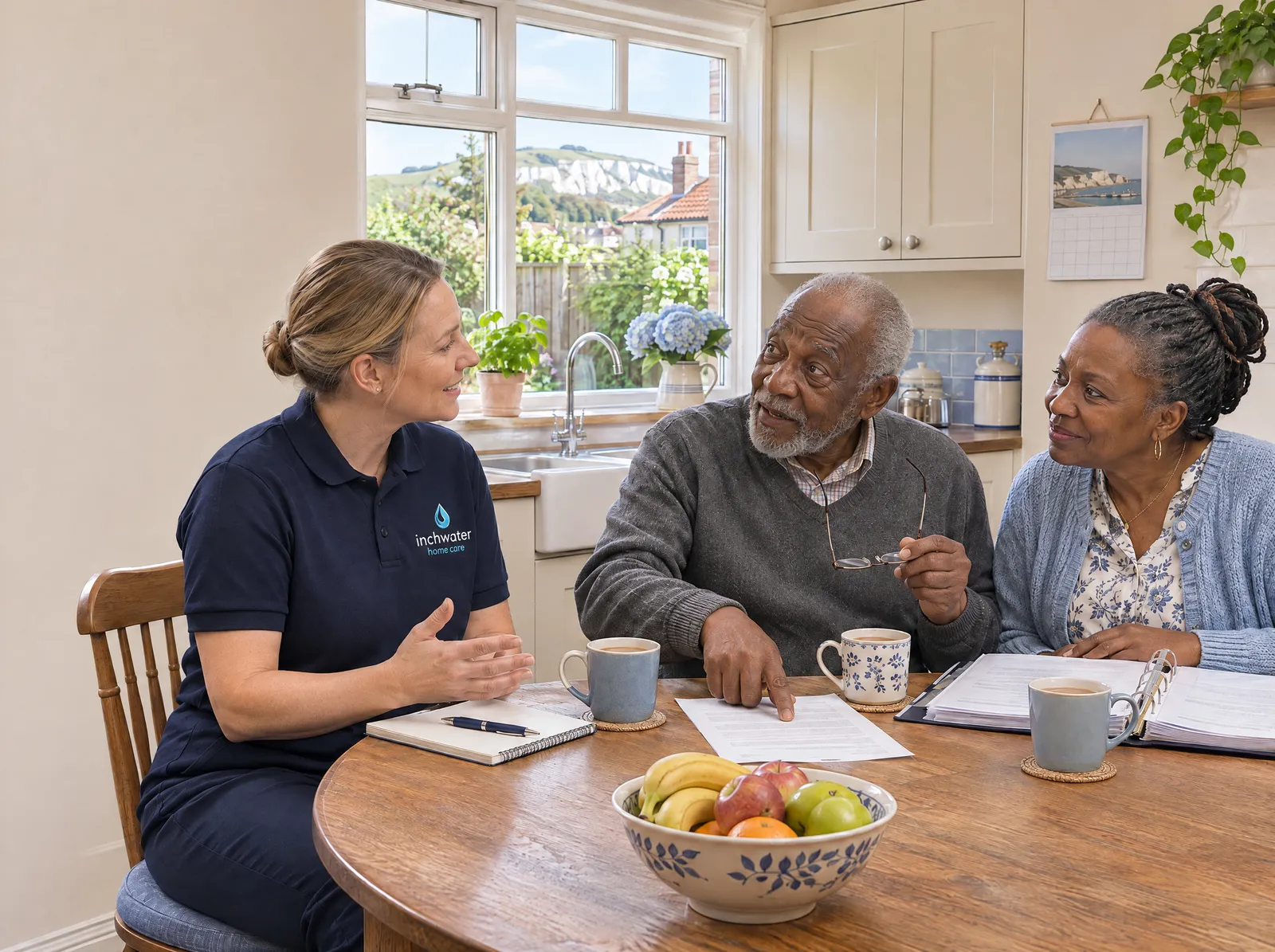
Inchwater care manager helping an older man and his daughter look over care funding letters at a kitchen table in Dover

Independent evidence you can check

Care Quality Commission

Rated Outstanding by the CQC

The independent regulator of health and social care in England

Rated Outstanding by the Care Quality Commission

Report published 10 September 2019

Report published 10 September 2019. In July 2023 CQC reviewed the information it holds about us and found no need to reassess our rating.

Read our CQC report (opens the CQC website)

Awards

Recognised regionally

homecare.co.uk Top Home Care Providers, South East England

  1. Top 10Home Care Providers, South East England2015
  2. Top 10Home Care Providers, South East England2017
  3. Top 20Home Care Providers, South East England2018

Quick answer

How can home care be paid for?

Home care in Kent is paid for privately from your own income or savings, by Kent County Council after a needs and financial assessment (often as Direct Payments) or by the NHS through Continuing Healthcare when needs are mainly health related. Many families combine these routes over time. Your needs and finances decide which applies.

Inchwater Home Care accepts all four routes. We are happy to explain them, but we do not decide who pays. That decision belongs to Kent County Council or the NHS, through their own assessments.

Four routes to funding care at home

    1. Paying privately

    If your savings and investments are above £23,250, or you would rather not involve the council, you arrange and pay for care yourself. You choose the provider, the visit times and the tasks. Many people who pay privately also claim Attendance Allowance, which is not means tested.
    1. Kent County Council funding and Direct Payments

    If you have eligible care needs, Kent County Council first assesses what support you need, then looks at your finances. With savings under £23,250 the council may contribute. You can ask for its share as a Direct Payment, then use it to choose a provider such as Inchwater.

    1. NHS Continuing Healthcare

    When a person's needs are mainly health needs rather than social care needs, the NHS may fund the whole package of care at home. It is not means tested, and the NHS assessment is separate from the council's. A fast track route exists for people nearing the end of life.

    1. A mix of sources

    Funding often changes over time. You might start by paying privately, receive council support as savings fall, then move to NHS funding if health declines. Some families also pay for extra hours on top of a council funded package.

What we do not charge for

Some parts of our service carry no charge, whoever is paying for the care itself.

  • Your care assessment

    A care manager visits you at home, listens and helps plan the support you want.

  • Care reviews

    We check in regularly and adjust the plan as needs grow or ease.

  • Telephone support

    Our Whitfield office can contact your GP or other services on your behalf.

Guides to each funding route

Will I have to sell my home to pay for care at home?

No. Kent County Council does not include the value of the home you live in when it looks at your capital for care at home. Savings, investments and any second property are counted. The rules for care homes are different, so check the details if a move is ever being considered.

How do I ask Kent County Council for a care needs assessment?

You can complete a self assessment or self referral through Kent County Council's care needs assessment page. You can also call 03000 41 61 61, Monday to Friday, 9am to 5pm. The assessment is free, and a family member can make the referral.

Can care start while the council assessment is underway?

Yes, if you are happy to pay privately in the meantime. Council assessments can take several weeks. Ask the council whether any funding could cover that period before care begins, as only the council can decide this.

Does a dementia diagnosis mean the NHS will pay?

Not automatically. NHS Continuing Healthcare depends on the nature, intensity, complexity and unpredictability of a person's needs, not on a diagnosis. Some people living with dementia qualify and many do not. Read about dementia care at home

Where can I get independent advice about paying for care?

Kent County Council gives information and advice at no charge. For personal financial planning, the Society of Later Life Advisers lists accredited advisers who specialise in later life and care funding. Independent charities such as Age UK also offer free guidance.

This is general information, not financial or legal advice. Figures apply to England for 2026 to 2027, taken from the GOV.UK social care charging circular and Kent County Council, and were checked on 23 October 2026. Funding decisions are made by Kent County Council and the NHS, not by Inchwater Home Care.

Talk it through with someone local

At your free assessment, a care manager will help you see which funding routes may apply and what to ask next.